Expand description
§Apache OpenDAL™ Rust Core: One Layer, All Storage.


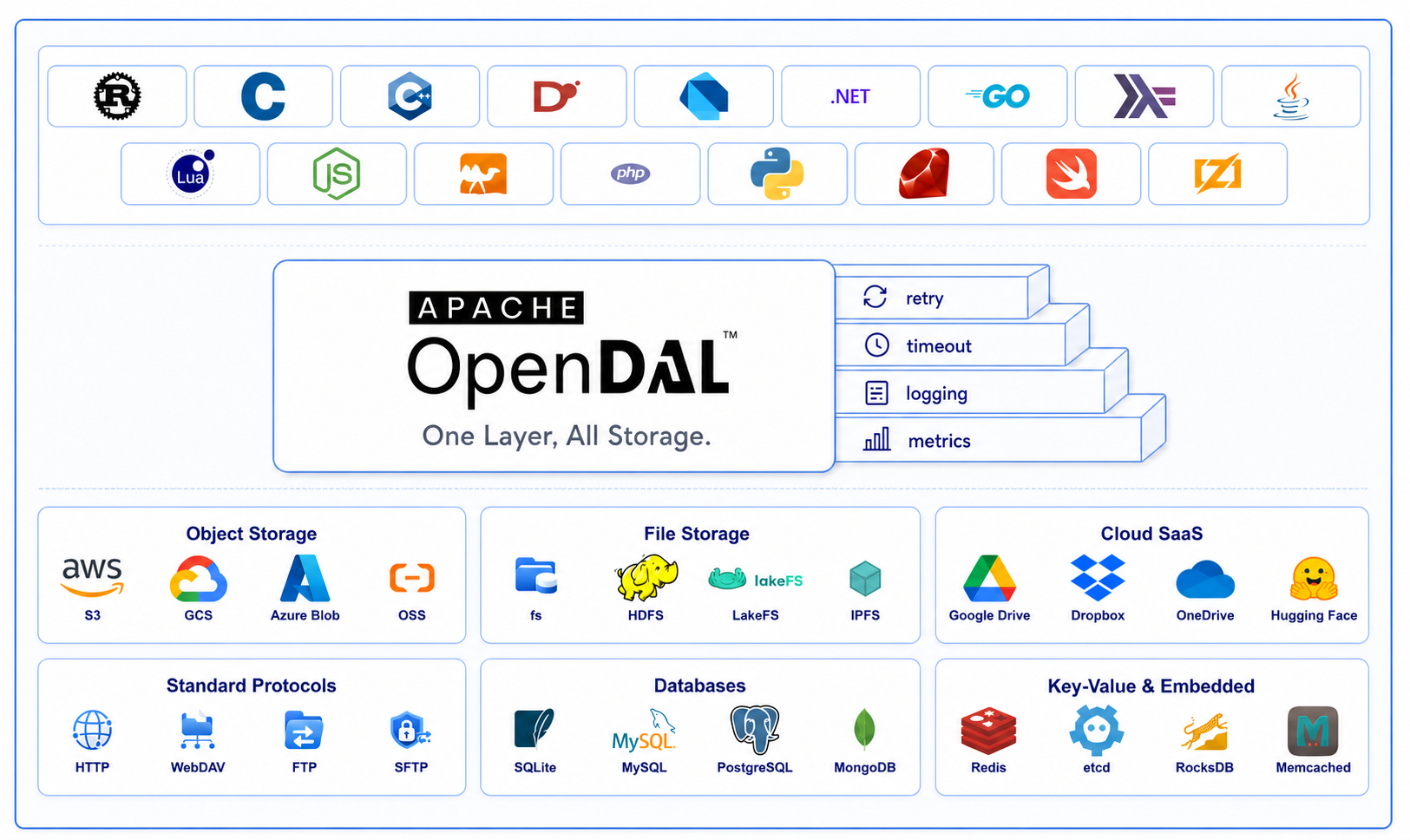
Apache OpenDAL™ is an Open Data Access Layer that enables seamless interaction with diverse storage services.
§Useful Links
- User guide: opendal.apache.org/docs/core — install, operations, layers, idioms, and extending the core.
- API reference: docs.rs/opendal (release) | dev
- Services & configuration: opendal.apache.org/services
- Concepts: opendal.apache.org/docs/concepts
- Upgrade Guide | Release Notes | RFCs
- Examples
§Installation
cargo add opendalEach service is a feature flag. The in-memory service is always available; enable
any other service with its services-* feature, e.g. features = ["services-s3"].
§Quickstart
use opendal::services;
use opendal::Operator;
use opendal::Result;

#[tokio::main]
async fn main() -> Result<()> {
    // Configure a service, then build an operator from it.
    let op = Operator::new(services::Memory::default())?;

    // The same verbs work on every service.
    op.write("hello.txt", "Hello, World!").await?;
    let bytes = op.read("hello.txt").await?;
    let meta = op.stat("hello.txt").await?;
    op.delete("hello.txt").await?;

    println!("read {} bytes", meta.content_length());
    Ok(())
}
To use a real backend, swap Memory for another service and configure it — the
operations stay identical. See Getting started
and Connecting to your storage.
§Services
OpenDAL talks to 50+ backends through one API. A selection by category:
| Type | Services |
|---|---|
| Standard Protocols | ftp, http, sftp, webdav |
| Object Storage | s3, gcs, azblob, oss, cos, obs, b2, vercel-blob, … |
| File Storage | fs, hdfs, azdls, azfile, webhdfs, ipfs, … |
| Consumer Cloud Storage | gdrive, onedrive, dropbox, aliyun-drive, koofr, … |
| Key-Value & Database | redis, etcd, tikv, rocksdb, sqlite, postgresql, mongodb, … |
| Cache | memcached, moka, mini-moka, ghac, vercel-artifacts |
See Services for the full list and each service’s configuration keys.
§Layers
Wrap an operator with layers to add retry, logging, timeout, metrics, and other cross-cutting behavior without touching your storage code. Retry, logging, timeout, and concurrency limit are built in:
use opendal::layers::RetryLayer;
use opendal::services::Memory;
use opendal::{Operator, Result};

fn build_operator() -> Result<Operator> {
    let op = Operator::new(Memory::default())?;
    Ok(op.layer(RetryLayer::new()))
}
See Going to production and the
layers module.
§Contributing
Check out the CONTRIBUTING guide for building, testing, and submitting changes to the core.
§Used by
Check out the users list for more details on who is using OpenDAL.
§Branding
The first and most prominent mentions must use the full form: Apache OpenDAL™ of the name for any individual usage (webpage, handout, slides, etc.) Depending on the context and writing style, you should use the full form of the name sufficiently often to ensure that readers clearly understand the association of both the OpenDAL project and the OpenDAL software product to the ASF as the parent organization.
For more details, see the Apache Product Name Usage Guide.
§License and Trademarks
Licensed under the Apache License, Version 2.0: http://www.apache.org/licenses/LICENSE-2.0
Apache OpenDAL, OpenDAL, and Apache are either registered trademarks or trademarks of the Apache Software Foundation.
Re-exports§
pub extern crate opendal_testkit as tests;
Modules§
- blocking
blocking - blocking module provides blocking APIs for OpenDAL.
- docs
- OpenDAL contracts, Rust core guides, and historical project documents.
- executors
- executors module provides implementations for the
Executetrait for widely used runtimes. - layers
- Layers enabled through
layers-*Cargo features. - operator_
futures - Futures provides the futures generated by
Operator - options
- Options module provides options definitions for operations.
- raw
- Raw modules provide raw APIs that used by underlying services
- services
- Service builders enabled through
services-*Cargo features.
Structs§
- Buffer
- Buffer is a wrapper of contiguous
Bytesand non-contiguous[Bytes]. - Buffer
Cursor BufferCursoris aRead+Seekcursor forBuffer, analogous tostd::io::Cursor.- Buffer
Sink - BufferSink is the adapter of [
futures::Sink] generated byWriter::into_sink - Buffer
Stream - BufferStream is a stream of buffers, created by
Reader::into_stream - Capability
- Capability defines the supported operations and their constraints for a storage Operator.
- Composer
- Creates one destination object from ordered complete source objects.
- Copier
Copierdrives a long-running copy operation one step at a time.- Deleter
- Deleter is designed to continuously remove content from storage.
- Entry
Entryrepresents an entry’s path and metadata.- Error
- Error is the error struct returned by all opendal functions.
- Executor
- Executor that runs futures in background.
- Future
Compose Source Composer::compose_withreturns this future.- Futures
Async Reader - FuturesAsyncReader is the adapter of [
AsyncRead], [AsyncBufRead] and [AsyncSeek] generated byReader::into_futures_async_read. - Futures
Async Writer - FuturesIoAsyncWriter is the adapter of [
AsyncWrite] forWriter. - Futures
Bytes Sink - FuturesBytesSink is the adapter of [
futures::Sink] generated byWriter::into_bytes_sink. - Futures
Bytes Stream - FuturesBytesStream is the adapter of [
Stream] generated byReader::into_bytes_stream. - Futures
Delete Sink - FuturesDeleteSink is a sink that generated by
Deleter - Http
Body - The streaming body returned by
HttpTransporter. - Http
Redirect - A reusable HTTP redirect handled by the transport.
- Http
Transporter - Type-erased HTTP transport handle.
- HttpUri
- An HTTP URI or relative location with a precomputed diagnostic representation.
- Lister
Listerlists entries at a given path asynchronously.- Metadata
- Metadata contains all the information related to a specific path.
- Metadata
Builder - Mutable construction state for
Metadata. - Operation
Context - Composed resources passed from operator to services and layers.
- Operator
- The
Operatorserves as the entry point for all public asynchronous APIs. - Operator
Info - Metadata for operator, users can use this metadata to get information of operator.
- Operator
Registry - Global registry that maps schemes to
OperatorFactoryfunctions. - Operator
Uri - Parsed representation of an operator URI with normalized components.
- Reader
- Reader is designed to read data from given path in an asynchronous manner.
- User
Metadata - Borrowed user metadata stored in a
Metadatavalue. - User
Metadata Into Iter - Iterator over borrowed user metadata pairs.
- Writer
- Writer is designed to write data into given path in an asynchronous manner.
Enums§
- Bytes
Range - BytesRange carries a range of content.
- Entry
Mode - EntryMode represents the mode.
- Error
Kind - OpenDAL error categories.
Traits§
- Builder
- OpenDAL uses
Builderto set up a service. - Configurator
- OpenDAL uses
Configuratorto configure a service. - Execute
- Execute trait is used to execute task in background.
- Http
Transport - HTTP transport used by OpenDAL services.
- Into
Compose Input - Converts a value into an owned source path and its composition options.
- Into
Delete Input - Converts a value into an owned path and logical delete options.
- Into
Operator Uri - Conversion trait that builds
OperatorUrifrom various inputs.
Functions§
- init_
default_ registry - Initialize the global
OperatorRegistrywith enabled services. - install_
default - Install the global defaults provided by the facade crate.
Type Aliases§
- Operator
Factory - Factory signature used to construct
Operatorfrom a URI and extra options. - Result
- A specialized
std::result::Resultwhose default error type isError.